
1. Medical fees: flat-rate fee or fee-for-service
In the health insurance sector, the model of a network of contracted healthcare providers with free choice of provider remains the predominant one, both in terms of premium volume and the number of insured individuals. However, the current model, based on paying healthcare professionals according to a fee-for-service schedule, is showing clear signs of strain. The relationship between insurance companies and healthcare professionals is becoming increasingly strained. The current model encourages dynamics that lead to dissatisfaction on both sides and, in the medium term, jeopardize the system’s sustainability.
This situation highlights the need to move toward a model based on a new form of mutual collaboration, one that adds greater value in three key areas:
- Improved care: raising the quality of patient care—for example, by ensuring that healthcare professionals have access to more comprehensive and integrated clinical information.
- Professional sustainability: improving physicians’ financial conditions and benefits package.
- Financial efficiency: optimizing insurance companies’ management of premiums to ensure the model’s viability.
It is worth recalling that capitation models—or per-capita payment models—which were at the origin of health insurance, preceded the current system of free choice and fee-for-service, until they virtually disappeared. Under that model, the insured person paid a premium in exchange for receiving care within a limited, preassigned network, with no choice in the matter. In return, the physician or provider received a fixed capitation payment per insured person, typically on a monthly basis, regardless of the actual use of the service.
This system had clear advantages and disadvantages.
- The main advantage was greater control over fluctuations in income and expenses, both for the company and for the professional.
- The main disadvantage lay in the limitation of the patient’s freedom of choice, which was restricted to the small number of options assigned.
Unlike the capitation model, the current model of free choice and fee-for-service encourages higher utilization and a reduction in the unit cost of the service. Furthermore, because costs depend directly on the insured person’s usage, they become variable and unpredictable, making it difficult to determine the claims cost in advance and, therefore, to clearly understand the revenue and expense margins for both companies and professionals.
Today, the digital transformation is introducing new tools and capabilities that allow us to rethink this scenario. Thanks to improved information management, care monitoring, and data analysis, it is possible to consider hybrid models that recapture the advantages of the capitation system while overcoming its original limitations. This presents an opportunity to consider the revival of an evolved capitation model, supported by digital management, that pursues two priority objectives:
- From the patient’s perspective, respecting and preserving the freedom to choose healthcare providers.
- From the perspective of physicians and insurers, controlling the cost and reimbursement of services, reducing claims variability, and improving financial predictability.

2. Characteristics of the digital capitation model
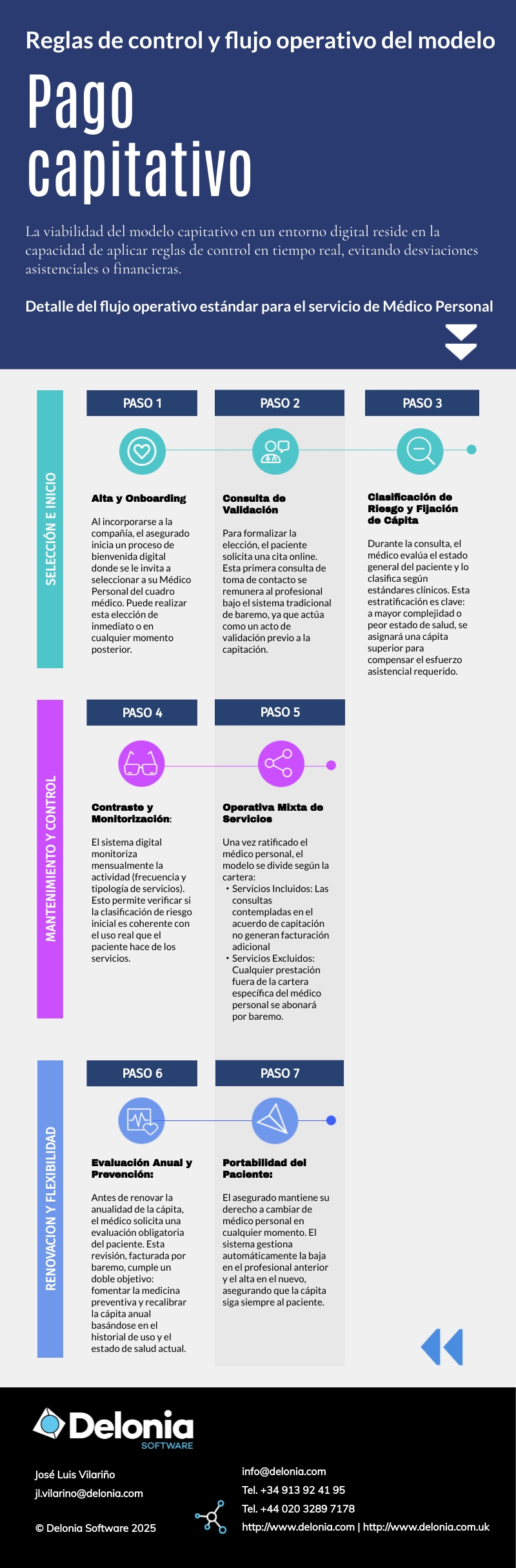
The digital capitation proposal outlines an operational framework that redefines the relationship between healthcare professionals and insurance companies. This model is structured around the following premises:
-
Segmentation by Specialty and Portfolio
For those high-frequency specialties, a fixed monthly payment (per capita) per insured person is established. This amount covers a specific, closed set of services. Other services not included in this catalog will continue to be reimbursed through the traditional fee-for-service system.
-
Selection and Assignment of the Professional
The new insured person selects (or is assigned) a primary care provider or clinical unit (e.g., family doctor, pediatrician, podiatrist) from the network of providers covered by their policy.
-
Registration Management and Immediate Notification
Upon assignment, the healthcare professional receives an automatic notification informing them of the new patient assigned to their quota, at which point they begin to earn the corresponding capitation payment.
-
Patient Flexibility and Mobility
Through their private account, patients are free to change doctors at any time. This action automatically registers the patient with the new doctor and deregisters them from the previous one, updating the payment records.
-
Smart Assignment Based on Patient Activity
Automatic assignment systems can be implemented such that, if the patient does not make an explicit choice, the system assigns them to a healthcare professional based on their activity history and actual use of the service. The assignment “follows” the patient’s activity.
-
Protocols for Occasional Use
The model includes specific rules for the occasional use of other resources within the medical staff (emergencies, vacation-related travel, etc.). These cases are handled without resulting in a change of primary care provider or altering the per-capita allocation.
-
Consolidation of “Favorites”
The user’s experience and frequency of visits will gradually shape their list of regular providers. Those marked as favorites or frequent providers will be the ones to receive the capitation payment.
-
Predictability and a Shift in Professional Approach
For the physician, this model guarantees a stable monthly income, making it easier to plan their practice. Since they are not dependent on generating clinical business, the physician can focus on building and attracting a loyal patient base, prioritizing personalized care that does not necessarily require in-person visits.
-
Follow-up and Renewal
The system requires mechanisms for the annual renewal of the per-capita payment. In return, professionals are required to conduct and document an annual clinical evaluation of each assigned patient, thereby ensuring proactive preventive care.

3. Technological Infrastructure of the Digital Lump-Sum Model
The viability of this model depends on an advanced technology platform that seamlessly integrates the private areas of patients and providers. The main objective is for the technology to act as a facilitating layer, abstracting the complexity of operational rules so that the end user experiences a simple process centered on the following pillars:
3.1. Clinical Recording and Traceability
The platform must automate the recording of all care-related activity by importing the consultation MBDs (Minimum Basic Data Set). This ensures that clinical information serves as the basis for validating capitation and continuity of care.
3.2. Digital Management Ecosystem for Professionals
It is essential to provide physicians with a suite of integrated tools that enable proactive—rather than merely reactive—healthcare management:
-
- Schedule Management: Online appointment systems synchronized in real time.
- Remote care channels: video consultation modules and telemedicine tools.
- Digital Prescribing: Management of electronic prescriptions and digital medical orders (lab tests, diagnostic tests, and referrals to specialists) with full traceability.
- Omnichannel Approach: Mobility tools and 100% online direct communication between doctor and patient.
3.3. Configuration of the Mixed Product
This technological platform makes it possible to establish a hybrid healthcare product. Within this product, the capitation system (for primary care specialists) and fee-for-service payments (for specific procedures) coexist harmoniously, guaranteeing patients free access to all the resources and services provided by the company’s medical staff.
Perhaps the fee-for-service model has reached its limit, which facilitates a transition to digital capitation. This hybrid system not only stabilizes the financial relationship between insurers and healthcare professionals but also represents a vital shift in approach by promoting preventive medicine. By freeing physicians from the pressure to perform a high volume of procedures, the model encourages proactive and personalized patient care that builds patient loyalty. In a way, digital capitation may be the key tool for ensuring the sector’s sustainability, aligning financial efficiency with maximum clinical and economic value: long-term health.
In an upcoming article, we will take a detailed look at the specific benefits this digital patient registration model offers to each of the three parties involved: the insurer, the patient, and the healthcare professional.