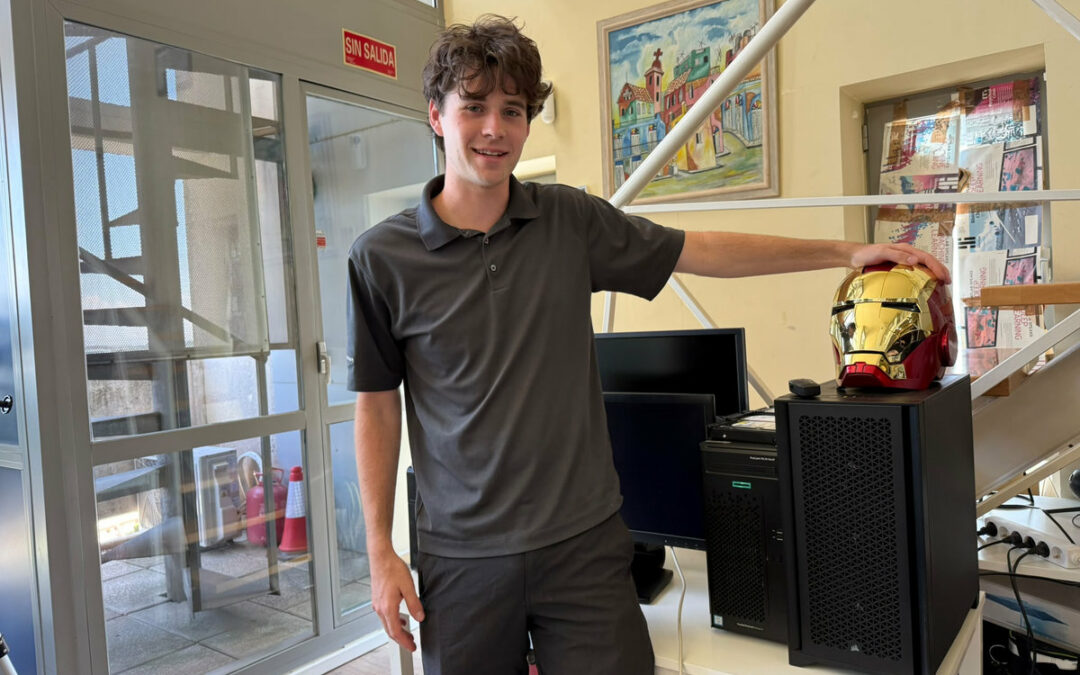
We had the opportunity to speak with Jackson Dejong, a 21-year-old American student who has spent two months in Delonia doing an international internship. Jackson has thrown himself wholeheartedly into his two projects, demonstrating a strong work ethic combined with tremendous enthusiasm. His future goal is to enter the workforce and combine his great passions: computer science, mathematics, and entrepreneurship.
Jackson, thank you so much for taking the time to speak with us. Could you please tell us a little bit about yourself?
My parents told me that before I had kids and got older, I could see the world and experience new things. My university offered some study abroad programs, and I figured I could kill two birds with one stone. Madrid really appealed to me—I’d never been to Spain before. I met some wonderful people through the program. My stay in Madrid lasted two months. I remember that on the first day I arrived, I didn’t know anything, and now everything feels almost familiar to me. After this short time, it feels natural to be here. Among the options were Paris and London, but I’d already been there, and besides, they were more expensive. There was an internship opportunity in Asia, but that option was really expensive.
You’re studying sports business at the University of Oregon, right?
Actually, I’m going to switch majors—I’ve decided to study Business Analytics and Operations. It’s a major that combines math and business. You calculate cash flow, figure out if a project has a chance of succeeding… I think it’s a better fit for what I want to do in the future; it’s more closely related to what I’m doing now. That’s what my next two years will look like. In Oregon, I used to visit small businesses and tell them that my specialty was solving their problems with AI tools. I also do some sales by talking to people on the phone. I help small businesses improve so they can attract more customers. I worked with a company that provided therapy services, but people kept missing their appointments. They didn’t have a good scheduling tool, so I built one for them using software. I love everything related to IT—building things and putting them together— things that work well. I don’t think I’m bad at them—neither math nor business. Here in Delonia, I’ve learned about sales and how to make something appealing. That experience will serve me well in the future.
CLINICAL RECORD, DIGITAL AND SHARED
Can you tell me how doctors in the United States can access patients’ medical records?
As is widely known, in the U.S., most people have private health insurance. On the other hand, a private company called Epic controls 70 percent of the medical records in my country. It holds hundreds of millions of medical records on U.S. citizens. A doctor in California can access the medical record of a patient in Texas; data is shared across the entire country. Epic has all that data and is very wealthy, so it’s very easy for them to share it. Here, the system is completely different—we have a public healthcare system—though I understand that the system isn’t very digitized, and sometimes patients have to go to the doctor with a folder full of documents.
ONLINE QUESTIONNAIRE FOR PATIENTS
Can you explain in simple terms what your job was like at Delonia?
I worked on two projects, both involving software for hospitals. One was designed to detect senile dementia. It consists of an online questionnaire for patients that allows doctors to determine whether or not they have senile dementia. This would help screen potential patients; not everyone would have to go to the hospital to find out whether or not they have senile dementia. Instead, the online test would serve as an initial screening, and only those with clear symptoms suggesting they might have the disease would be referred to the hospital. It is feasible to create an online test to determine whether a patient is suffering from senile dementia, depression, anxiety, etc. The person would not need to travel to the hospital, which is an advantage for both the individual and the hospital (which could then focus on those who are actually ill).
Let me give you an example: a woman might think her husband is starting to show symptoms of cognitive decline. All her husband would need to do is take the online test. If the result indicates, say, a 75% chance that he may indeed be experiencing cognitive decline, then he should go to the hospital. Many people go to a clinic unnecessarily.
The other project was to create a timeline of the patient’s medical history that was as visual as possible—one that was easy to view and interpret. The software would allow the doctor to get a quick overview of the medical history of the patient they are about to treat at a glance.
What did you like most about Spain, and what did you find most difficult?
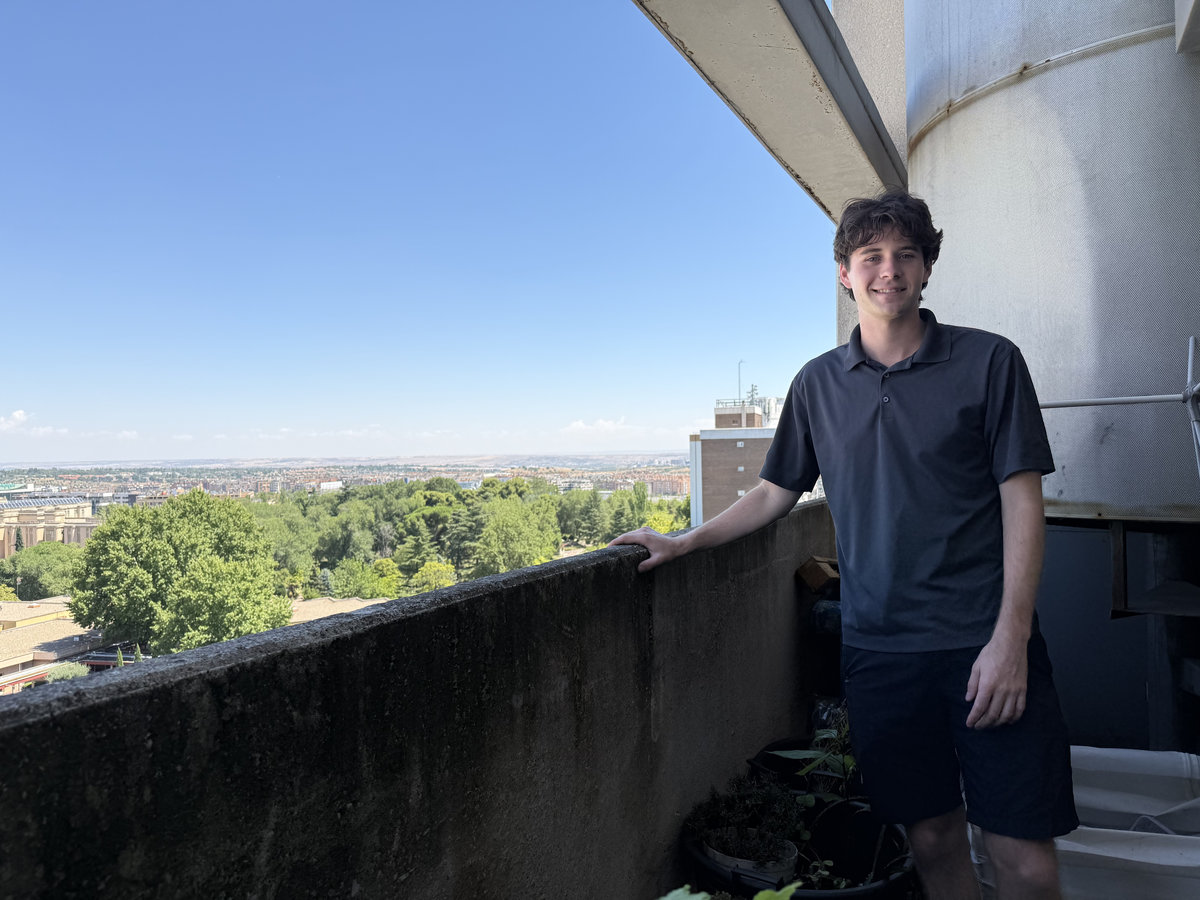
The heat here in Madrid is really intense; in Ibiza and Barcelona, it was very humid, which made it even worse. I’m studying in Oregon, where it’s very cold and it rains a lot—the weather there isn’t very good. My family lives in California, where the weather is almost always nice. I’m used to the heat—my family also used to go to Texas a lot, where it’s very hot. Now I’m used to the heat in Madrid.
The food here is much better; I haven’t eaten anywhere where I didn’t say, “What great food!” I haven’t had a bad experience with the food here, but I miss the places in the U.S. where I often go to eat. I miss driving from one place to another—that’s how people get around in my country. Here, you have to walk or take the subway. I like driving my car.
Not knowing Spanish has been difficult, but luckily most people in Delonia speak English. I’ve learned a lot of Spanish in just two months, but it’s been a challenge. Before coming here, I knew a little Spanish, but very little. I’ve loved working on projects, having the freedom to create things… and presenting the things I’ve created. It’s been a wonderful experience. I’ve gained a lot of experience when it comes to creating things, and now I’ll use that in my business to build something really big.
Tell me something you haven’t been able to do in Delonia but would have liked to…
At Delonia, I got what I was looking for, but I think working on a project with a team of people would have been a great experience. In any case, I had the opportunity to ask my colleagues at Delonia questions all the time.
AI: BENEFITS AND RISKS
What are your plans for the future?
I have two more years of college left. I’ve learned a lot by using AI as a tool. When I graduate, I’ll try to find a job that combines two areas: AI development and entrepreneurship. I’d like to start my own business. By the time I turn 23, I’ll have graduated and will have to decide whether to continue my studies or start working. I’d like to join a large company or start my own business, or stay in college, earn a master’s degree, and once I’m done, start my career at a higher level.
What do you think about AI?
I think everything is evolving very quickly; I think AI helps humans be more efficient. AI is going to be in every field, and we need to use it to our advantage. We’ve already seen thatAI can “get out of control,” and that’s a little scary. The big companies developing AI are thinking more about money than about safety. I think there will come a time when they release something that’s truly dangerous. It could be so powerful that it would be like an atomic bomb. There needs to be a global consensus to regulate AI.
Where do you see yourself in 30 years?
Professionally, I think I’m good at working with people; I’d like to be in a position of responsibility, perhaps in the U.S., or maybe outside my country. I’d like to have a family—this is very important to me. I want to stay up to date with the latest technology and make the most of it. I’d like to be able to say that I worked hard and accomplished something important. It doesn’t matter to me if that’s when I’m 40, 50, or 75… I want to feel proud of my life and give my parents grandchildren.