

Following on from the content of our January 12 article, we have decided to take a closer look at the digital captive model. To do so, it is necessary to analyze and resolve some key issues that will optimize both its effectiveness and the user experience.
We would particularly like to focus on two important aspects: the fact that not all patients are the same and the definition of the products associated with the digital capitativo model.
Understanding these points will allow you to understand the business rules that govern the model.

1. Risk segmentation: not all patients are the same.
The traditional capita fixed a price per patient regardless of their clinical needs. This could encourage the provider to avoid complex patients, since they required greater dedication than stable or healthy patients. To correct this problem or bias, it is essential to make the capitated model more sophisticated through compensation mechanisms. In this way, the capita would become variable, adjusting to parameters such as age or state of health.
1.1. Age adjustment
The implementation of an age-based capita is straightforward, as it can be linked directly to the premium segmentation already used by insurers. In this scheme, the provider would receive an amount adjusted to the age of the assigned patient. However, the main drawback is that age alone does not guarantee that patients who require more intensive medical care are being adequately compensated.
1.2. Adjustment for health status
A capitated model based on patient health status is significantly more accurate and fair. Unlike the age criterion, this approach allows the population to be classified into specific clinical categories.
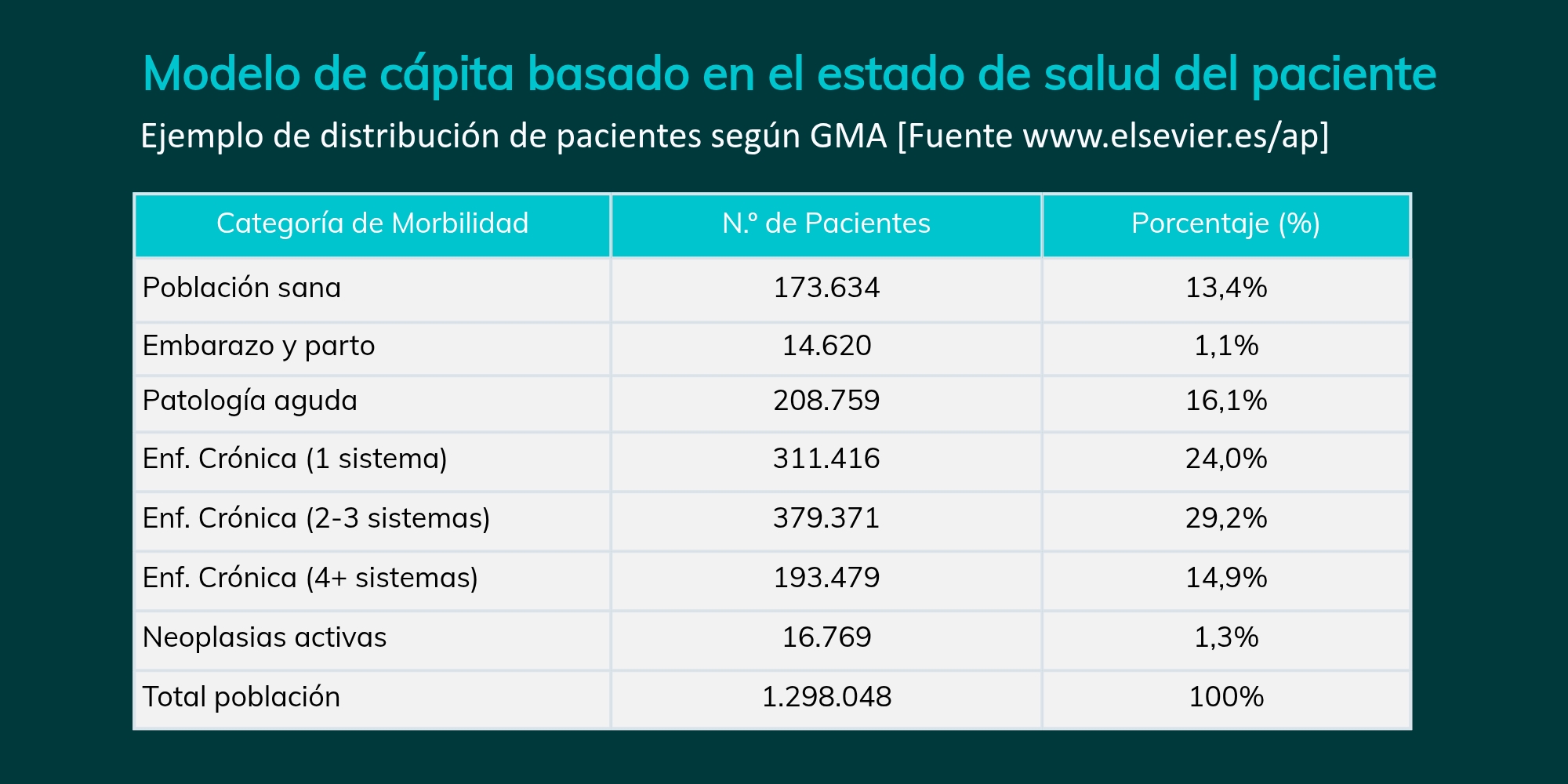
This classification can be self-designed or based on already validated methodologies, such as the Adjusted Morbidity Group (AMG). This system organizes patients into seven categories, also assigning five levels of complexity to each (except for the healthy population), which allows for a much finer actuarial adjustment.
Structure of the GMA model:
- Healthy population
- Pregnancy and/or childbirth
- Acute pathology
- Chronic disease in 1 system
- Chronic disease in 2 or 3 systems
- Chronic disease in 4 or more systems
- Active neoplasms
To illustrate the relevance of this parameter in the calculation of capita adjustments, we present a real example of population distribution according to the GMA model:
1.3. Initial cataloging and reevaluation
For the GMA-based model to be effective, our digital platform will manage the patient’s clinical classification in two critical phases:
- Initial Enrollment (Welcome Pack): An initial medical evaluation will be conducted to open the medical record and assign a risk category. Although it is possible to use the enrollment questionnaire, we recommend an initial clinical assessment to ensure the accuracy of the capitation payment from day one.
- Dynamic reassessment using AI: The system will periodically update the patient’s category by analyzing CMBD reports. We currently have an AI prototype that processes diagnoses ICD-11 during each visit to automate this complexity adjustment under medical supervision.
1.4. How to promote the doctor-patient relationship
A relevant aspect of the model is to prevent the fixed payment from discouraging healthcare activity or limiting the clinical relationship to the patient’s initiative in the face of a health problem. To minimize this effect, business rules are proposed such as:
- Annual renewal of the capitation payment: Payment will be contingent upon an annual checkup and follow-up visit, during which the physician must complete a health assessment. This service would be paid as an additional incentive; without this assessment, the monthly capitation payment would be suspended.
- Mandatory initial consultation: An initial consultation (preferably via video call) is required with each newly assigned patient to assess their health status and present the available preventive care plans, even for healthy patients. The formalization of this plan, which includes the initial documentation of the medical history (medical history, allergies, etc.), would be an essential requirement for beginning to receive the capitation payment and could be accompanied by a financial incentive.

2. Products associated with the digital subscription model
As mentioned, this model is optimal for high frequency and low clinical intensity specialties. Its implementation is projected in three main product typologies:
2.1. Types of products
- Personal Health and Healthy Living Plans: low-premium products aimed at young people and those interested in healthy lifestyles. They include preventive and wellness services, such as gym memberships and personal trainers.
- Insurance for Seniors: designed as a standalone or supplemental product. In this model, the assigned physician acts as a health manager and advisor, coordinating referrals to specialists. The plan offers a premium discount to patients who enroll in this guided care program.
- Supplement to Traditional Insurance (Family Physician): The physician takes on comprehensive management of the family’s health (ideally, the same professional for the entire household). This role includes prescribing medications, ordering tests, and managing referrals. This approach reduces the fragmentation and duplication of expenses caused by uncontrolled access to the network of providers, improving insurance risk management and, consequently, the premium.
2.2. Key specialties for implementation
Encouraging the assignment of trusted (favored) physicians who manage family health holistically improves user experience and cost efficiency. The most appropriate areas are:
- Primary Care / Family / Personal Physician.
- Pediatrics and Gynecology.
- Psychology and Podiatry.
- Wellness and healthy living plans.
2.3. Flexibility and telemedicine
The assignment of the physician is always the patient’s decision, and the patient may change his or her choice at any time. This choice can be:
- Means: through direct user action.
- Implicit: through an algorithm that automatically assigns a healthcare provider based on the insured person’s usage history (favorite doctors).
It is important to note that the assigned physician does not necessarily require a physical presence nearby. The model allows for delocalization, making special sense when the professional has specific expertise (sports medicine, dietetics, etc.) that is of interest to the insured. Through our online care platform, telemedicine guarantees quality clinical management regardless of geographical location.
3. Conclusion
In essence, this model proposes a profound transformation in the behavior and operations of all those involved. For the patient, it guarantees immediate and personalized access to services, while preserving the patient’s freedom of choice. For the professional, it shifts the focus from the generation of medical acts to proactive, health-centered follow-up. Finally, for the insurance company, it represents a leap in risk control through precise knowledge of the state of health of its policyholders.